Can Universities Adopt AI Without Turning Students Into Experiments?
“Artificial intelligence has the potential to enhance the collegiate learning experience and expand access to educational resources, but innovation must be paired with transparency and accountability.”
California Assemblymember Mike Fong
As universities race to integrate artificial intelligence into classrooms, research workflows, and campus systems, a more complicated question is beginning to surface: what happens when institutional enthusiasm outpaces student trust, faculty readiness, and evidence about how AI affects learning?
That question has become especially visible across the California State University system, where a major partnership with OpenAI makes ChatGPT Edu available to more than half a million students, faculty, and staff. The agreement has been renewed in 2026, and frames this as a landmark step toward AI-enabled education, giving one of the nation’s largest public university systems a way to expand access, strengthen AI literacy, and prepare students for a job market already being reshaped by generative tools.
Yet adoption at that scale also exposes a deeper challenge. Widespread use does not automatically produce confidence. A recent university-wide survey found that many students and faculty are already using AI, while also expressing concern about its effect on academic integrity, creativity, future jobs, bias, environmental costs, and critical thinking. For some students, the issue is whether universities are introducing AI with enough transparency, pedagogical clarity, and evidence to show that the tools serve learning rather than merely normalizing their presence.
The CSU case points to a broader dilemma for higher education. Universities cannot ignore AI, especially as students encounter it in workplaces, research settings, and everyday digital life. But when AI becomes part of campus infrastructure before institutions have settled questions of assessment, autonomy, privacy, and classroom expectations, students can begin to feel less like learners and more like participants in an unfinished experiment.
To better understand how this tension is unfolding in practice, we spoke with Dr. Ed Clark, chief information officer for the CSU Office of the Chancellor; Dr. Leslie Kennedy, assistant vice chancellor of Academic Technology Services at CSU; and California Assemblymember Mike Fong, who authored AB 2392, a bill aimed at establishing AI policy and training requirements for faculty and staff in California’s public higher education systems.
Meet the Experts

Ed Clark, EdD serves as chief information officer for the California State University Office of the Chancellor, where he helps oversee systemwide information technology strategy for the nation’s largest public four-year university system.
Dr. Clark holds a doctorate in education from Minnesota State University, Mankato, a master’s in management of technology from the University of Minnesota, and a bachelor’s degree in English from Florida State University. Additionally, he currently teaches information systems in the Information Systems and Decision Sciences department at the College of Business and Economics at California State University, Fullerton.
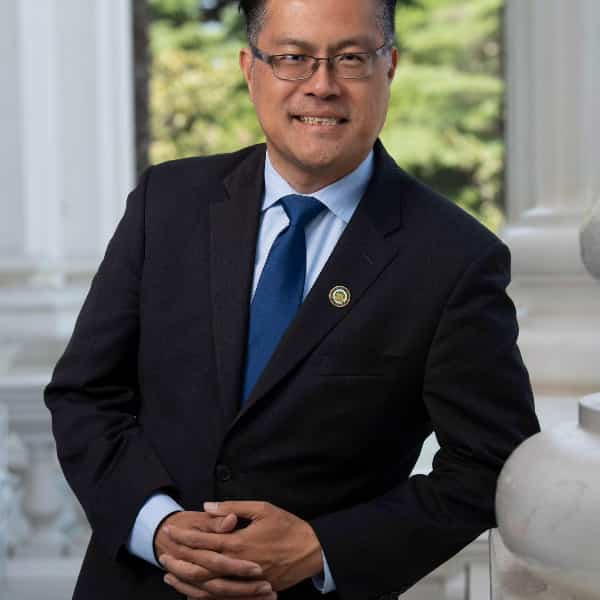
Assemblymember Mike Fong represents California’s 49th Assembly District in the State Assembly. A native of Los Angeles County, Mr. Fong holds degrees from California State University at Northridge in a master of public administration in public sector management and leadership and from the University of California at Los Angeles with a BS in psychobiology and a minor in education. He enjoys Dodger Baseball and UCLA athletics.

Leslie Kennedy, EdD is assistant vice chancellor of Academic Technology Services at the California State University Office of the Chancellor. She provides leadership focused on systemwide academic technology, libraries, online education, and affordable learning initiatives. She also co-leads the academic aspects of CSU’s Generative AI initiative to advance responsible adoption, enhance teaching, learning, and administration.
CSU’s Case for Access Over Avoidance
For CSU officials, the decision to provide systemwide access to ChatGPT Edu begins with a pragmatic concern: students, faculty, and staff are already using generative AI tools, often through public platforms that offer fewer institutional safeguards.
Dr. Clark says the system’s approach is guided by the CSU Generative AI Advisory Committee, which includes students, faculty, and staff. In a 2024 report, the committee recommended that CSU “promote inclusive access to GenAI technologies and ensure that all CSU faculty, staff, and students have access to GenAI tools and training necessary to leverage them for teaching, learning, research, and work.”
The same report acknowledged that CSU community members were already using publicly available AI tools without data protections. It recommended that “efforts should be made to use enterprise solutions with commercial data protection where feasible, rather than freely available tools on the open web.”
“The CSU acted responsibly and thoughtfully to bring AI tools to its universities,” Dr. Clark says.
That reasoning places CSU’s rollout within a larger access question. If generative AI is already part of student and faculty life, leaving adoption to individual subscriptions or open-web platforms can deepen uneven access and make privacy protections harder to manage. A systemwide enterprise model gives CSU a way to provide the same tool across campuses while bringing use into a more structured institutional environment.
Dr. Clark says CSU evaluated several companies offering AI tools for higher education before selecting OpenAI. “It was only after conducting this evaluation that CSU determined OpenAI offered the most cost-effective option that could make it even possible to bring AI tools to more than half a million students, faculty, and staff,” he says.
The rollout therefore begins with a promise of access. But access is only the first layer of university AI adoption. Once a tool is available to everyone, the harder questions move into the classroom: how it should be used, who decides, and what students are supposed to learn from it.
When AI Enters the Classroom
Complexity is immediately introduced in a system as large and decentralized as CSU, where academic disciplines, campus cultures, and faculty expectations vary widely. A systemwide AI tool can create a common point of access, but it does not create a single approach to teaching, assessment, or academic integrity.
CSU says those decisions belong largely with faculty. Dr. Kennedy says the system has chosen not to impose one rule for AI use across every classroom. “The CSU respects academic freedom and believes decisions about AI in the classroom are a faculty purview,” Dr. Kennedy says.
That approach gives instructors room to decide how AI fits their courses. In one class, generative AI may be treated as a prohibited shortcut. In another, it may be used for brainstorming, coding, research support, drafting, or revision. Some instructors may redesign assignments around AI use, while others may focus on disclosure, detection, or limits on when the technology is allowed.
For students, that variation can be difficult to navigate while norms are still forming. A student may be encouraged to use AI in one course and warned against it in another, even when both courses are part of the same degree pathway. The result is a classroom landscape where access to the tool may be standardized, but expectations around its use remain uneven.
Dr. Kennedy says CSU’s strategy is designed to support faculty, students, and staff as AI changes academic fields and the workplace. “The intent of our strategy is therefore not to mandate the use of AI but to increase AI literacy by providing the tools, training, and resources that will help create greater understanding of and how to use AI effectively and responsibly,” she says.
For CSU, AI literacy is the bridge between access and classroom practice. The system can make the tool available, but faculty and students still need shared expectations around what responsible use looks like in real assignments, research tasks, and assessments.
CSU says that guidance will continue to develop. “The CSU will continue to establish frameworks to reduce confusion and standardize best practices across the system,” Dr. Kennedy says.
The challenge is that frameworks must do more than explain which tools are available. They have to help faculty and students decide when AI supports learning, when it weakens it, and how much responsibility should remain with the learner. Once those questions affect an entire public university system, they become questions of transparency, governance, and public trust.
Public Accountability
For public university systems, AI adoption is also a matter of public accountability. It raises questions about privacy, disclosure, and who gets to shape the rules for tools that may influence teaching, learning, and work across an entire campus community.
Assemblymember Mike Fong frames the issue as one of promise and responsibility. “Artificial intelligence has the potential to enhance the collegiate learning experience and expand access to educational resources, but innovation must be paired with transparency and accountability,” Fong says.
That responsibility is becoming more urgent as colleges and universities move from experimenting with AI to embedding it in campus systems. Students may encounter AI through writing assignments, research tools, tutoring platforms, advising systems, or classroom policies. Faculty may be asked to use or respond to technologies whose boundaries are still being defined. Staff may face new administrative uses of AI before institutional norms are fully settled.
Fong says faculty, students, and staff need clearer information about how AI tools are used and governed. “As public colleges and universities continue adopting AI tools, faculty, students and staff need clear guidance on how these technologies are being used and what safeguards are in place to protect privacy,” he says.
That need for guidance becomes especially important when universities adopt AI at scale. A campus contract can make a tool widely available, but it does not automatically answer how data is protected, how students are informed, how faculty are trained, or how institutions measure whether AI is improving education. Those questions require governance that is visible enough for students and faculty to understand, not only internal enough for administrators to manage.
For Fong, AB 2392 is part of that effort. “That is why I authored AB 2392, which establishes AI policy and training for faculty and staff in California’s public higher education systems,” he says.
The bill’s emphasis on policy and training points to a larger principle: AI adoption in public education needs structures that keep people, not platforms, at the center of decision-making. As Fong puts it, “California has an opportunity to lead by ensuring AI is deployed thoughtfully, ethically, and in a way that keeps faculty, students, and staff at the center of every decision.”
That standard brings the CSU rollout back to its central test. Access may address one form of inequality, and faculty discretion may preserve academic freedom, but trust depends on whether students and instructors can see how decisions are made, what protections exist, and how the technology is supposed to serve learning.
The Measure Is Learning
For CSU, the long-term test of the OpenAI rollout is not simply whether students and faculty use the tool. It is whether access to generative AI helps the university system strengthen teaching, learning, and preparation for life beyond graduation.
Dr. Kennedy says CSU’s AI strategy is grounded in “equitable access, academic excellence and career readiness.” The system’s goal, she says, is to support faculty with tools and resources that help them teach effectively while preparing students for a changing workforce. “Our commitment to our students is that when they graduate, they will be prepared to enter a rapidly evolving job market with the tools to be successful,” she says.
That goal reflects the strongest case for university AI adoption. If students are likely to encounter generative AI in their careers, universities have a responsibility to help them understand how the technology works, where it is useful, where it is limited, and how to use it without surrendering judgment. AI literacy, in that sense, is part of a broader educational question about how students learn to evaluate information, produce original work, and make decisions in environments shaped by automated systems.
CSU officials describe the strategy as an evolving process rather than a fixed settlement. Dr. Clark says the system renewed its agreement with OpenAI after “extensive evaluation and input from stakeholders across the system,” including the CSU Gen AI Advisory Committee and its subcommittees, which he says “unanimously recommended renewing the contract.”
“The CSU’s AI strategy is also not considered static but rather iterative,” Dr. Clark says. “The strategy will continue to consider the changing needs of our campus communities in response to the impacts of AI on education and the workforce.”
That iterative approach matters because the questions surrounding AI in higher education will keep changing. Tools will become more capable. Employers will shift expectations. Faculty will continue to test new uses and limits. Students will bring their own experiences, skepticism, and habits into the classroom. A strategy that works at launch may need to be revised as institutions learn more about how AI affects attention, writing, research, creativity, assessment, and trust.
The challenge for CSU, and for universities watching its example, is to make that learning visible. Access can be counted through accounts, licenses, and training sessions. Educational value is harder to measure. It depends on whether students gain skills without losing independence, whether faculty receive enough support to make thoughtful choices, and whether institutions are willing to adjust course when evidence, not enthusiasm, demands it.
Universities cannot keep AI outside the gates of higher education. But they can decide what kind of adoption they are willing to defend. The measure should not be how quickly a system deploys a tool, or how large a partnership becomes. It should be whether AI helps students become more capable thinkers in a world where the technology is already reshaping how knowledge is found, produced, and judged.