Galileo Galilei – The Father of Modern Science
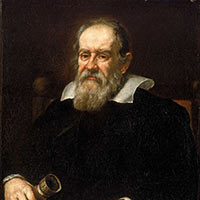
On the last day of October in 1992, Pope John Paul II offered the first of several rather unexpected apologies for past actions of the Catholic Church. It was over three hundred years too late to make much of a difference, but it acknowledged that the Roman Inquisition, the Catholic Church, and Pope Urban VIII had been on the wrong side of history in 1633, when Galileo Galilei was tried and prosecuted for heresy. Mistakes had been made by those who had prevailed upon one of Italy’s great men of science to recant that which he had merely observed: that the Earth was not the fixed center of the universe, but one of several known planets in orbit around the Sun.
This conflict between the Church and one of the first practitioners of modern science is often referred to as “the Galileo affair,” in part because it encompasses far more than just a question of science. Galileo’s methodology and his discoveries were the focal point for a vast revolution in science that engulfed Europe in the 17th century, sowed the seeds for the European Enlightenment of the 18th century, and created the foundation for much of contemporary culture and thought. In that sense, he was the ultimate disruptor, a rigorous polymath, innovator, and tinkerer who questioned convention, redefined the rules of science, and ultimately upended a belief system that separated the ancient world from modernity.
Who Was Galileo?
Galileo was born on February 15, 1564, in the town of Pisa. His father was a musician and a composer, and Galileo also studied music as a child. At the age of eight, Galileo’s family moved to Florence, and he began formal schooling at the Benedictine abbey of Vallombrosa, where he would have learned classical Greek, Latin, and logic in training to become a monk. Ruled at the time by the Medici family, Florence was a powerful political and economic center with a rich intellectual tradition, and the setting for much of what Niccolò Machiavelli had observed and recorded in his 1513 treatise The Prince.
Galileo returned to Pisa, which was then part of the Duchy of Florence, in 1581 to attend university. He began studying medicine in the hopes of becoming a physician but, during his four years at the University of Pisa, he was drawn more toward Euclidean geometry, mathematics, and scientific research. He abandoned his pursuit of a medical degree after four years of study, and began experimenting with pendulums and hydrostatic forces. The latter led to the publication of his first book, La Billancetta (The Little Balance) in 1586, and to the first inventions he is credited with: the hydrostatic balance described in La Billancetta, and a thermoscope, which was a precursor of thermometer.
There were early signs of iconoclasm, populism, and a tendency toward eclecticism in the young Galileo. Rather than publishing his works in Latin, the language of the Church, he opted to write in the vernacular: common Italian. His first university appointment was teaching art at Florence’s Accademia delle Arti del Disegno in 1588, and he gave two published lectures on the dimensions of Dante’s Inferno that year to the Academy. The following year, at the age of 25, Galileo received an academic appointment more in keeping with his true talents, as Chair of Mathematics at the University of Pisa. In what might be seen as an amusing harbinger of future conflicts with authority, Galileo ran afoul of the dress code at the University of Pisa, which required lecturers to wear togas. After being fined for this violation, he wrote a long, satirical poem titled Against the Donning of the Gown, which appeared in 1590.
Galileo would go on to teach mathematics at one of Italy’s top academic institutions, the University of Padua, from 1592 until 1610, the year he published one of his most famous books, Sidereus Nuncius, or Starry Messenger. It was this book that set forth the astronomical observations that suggested the Earth was not the fixed center of the universe, and that initiated Galileo’s first conflict with Church authorities. He only received the equivalent of a stern warning for the ideas he set forth in Starry Messenger, and would not be formally sentenced by the Inquisition until a second trial, in 1633, following the publication of his more notorious Dialogo sopra i due massimi sistemi del mondo, or Dialogue Concerning the Two World Systems.
Although he never married, Galileo did father two daughters (Virginia and Livia) and one son (Vincenzo) with Marina Gamba, Following his trial before the Roman Inquisition in 1633, Galileo was forced to live out the remainder of his life under house arrest, which allowed him to complete and publish in 1638 his most comprehensive examination of physics and the scientific method: Discourses and Mathematical Demonstrations Relating to Two New Sciences. Galileo died in 1642, the year of Isaac Newton’s birth. Coincidentally, Michelangelo had died in the year of Galileo’s birth, 1564. William Shakespeare was also born in 1564.
Galileo’s Contributions to Science
Depending on the context in which his achievements are assessed, Galileo can and has been hailed as the father of observational astronomy, the father of modern physics, the father of the scientific method, or, as Albert Einstein famously noted, “the father of modern science.” What is clear is that Galileo’s scientific work was not confined to any one area. He is best known for his astronomical observations, which included the features of the Moon, the phases of Venus, four of Jupiter’s moons, and Sunspots, as well as for the then radical theories that flowed logically from those observations. But he was also a dedicated tinkerer, who optimized the telescope for military and then scientific use, and used geometric calculations to improve the accuracy of the ballistic and military compasses of the day. And, he engaged in what we would now designate as pure research, conducting rigorous experiments on objects and materials, carefully collecting data, and subjecting that data to mathematical analysis in order to obtain objective and replicable results.
It is in this way, through his empirical approach to obtaining and analyzing data, that Galileo can be seen to have pioneered the scientific method. Rather than seeking out evidence that would confirm and conform to a certain orthodoxy or ideology, Galileo aimed to arrive at whatever conclusions a careful analysis of evidence would suggest. Those conclusions then informed his theories, even if they contradicted established doctrine and convention. For example, one experiment Galileo never actually conducted, although he told this story to a biographer later in his life, involved dropping two cannonballs of different weights from atop the Tower of Pisa. The point would have been to demonstrate that they would land at roughly the same time, directly contradicting the accepted Aristotelian notion that the rate at which objects fall is proportional to their weight. Galileo didn’t have to drop cannonballs to prove the fallacy of Aristotelian physics; he’d already collected enough data from less perilous experiments to know the inevitable results.
Galileo did not operate in a vacuum. The Polish astronomer Nicolaus Copernicus formulated a heliocentric model of the solar system in the early 16th century, and his ideas had been published in the treatise On the Revolutions of the Celestial Spheres shortly before his death in 1543. Galileo built and perfected the telescope he used to observe the geography of the Moon, the phases of Venus, and the moons of Jupiter. But, the idea for the telescope came by way of a Dutchman named Hans Lippershey, who’d applied for a patent on the invention in 1608. And, while Galileo got a lot of things right through his empirical observations of the night sky, he had a few notable misses. For example, he postulated that the tidal motion of the seas was attributable solely to the rotation of the Earth on its axis, neglecting to factor in the gravitational pull of the Moon. It was a contemporary of Galileo’s, Johannes Kepler, who first described the Moon’s tidal pull, and who corrected Galileo’s description of planetary orbits by pointing out that they were elliptical, not circular.
The Galileo Affair
Galileo’s overarching contribution to modern science was his systematic development, implementation, and description of a scientific method predicated on evidence-based research. This he laid out most cogently and categorically in two books: 1623’s Il Saggiatore (The Assayer), and the Two New Sciences discourse published in 1638. But, his historical impact and legacy is bound up in his astronomical observations, the conclusions he drew from these, and the reaction of Church authorities to the results.
It’s hard to pinpoint exactly when Galileo reached his revolutionary conclusion that the Sun, not the Earth, must be the center of the solar system, and that the heavenly perfection set forth by Aristotle, and codified in the Ptolemaic system, was fallacious. By most accounts, it was a cumulative process of discovery. His initial telescopic observations revealed the geographical features of the Moon. As he improved the magnification properties of his telescope, he was able to study the shadows that crossed the face of Venus, the moons in orbit around Jupiter, thousands of stars from distant galaxies that could not be seen by the naked eye, and distinct features of the Sun. He could then employ mathematical calculations to confirm what he would have already suspected regarding the true nature of the cosmos, and by 1609 he was synthesizing these evidence-based ideas in the text that would become Starry Messenger.
Galileo was certainly aware of the perils of contradicting Church doctrine. However, by the early 17th century the messages coming from the Church regarding scientific research were mixed. In 1593, the Dominican friar, mathematician, and astronomer Giordano Bruno had been burned at the stake on the orders of the Inquisition for the heretical crime of promoting ideas that ran counter to Ptolemaic geocentrism and thus Church teachings. But, within certain sectors of the Catholicism there had been a gradual acceptance of science and enlightenment. In 1582, under Pope Gregory XIII, the Catholic Church had adopted the Gregorian calendar, which used calculations based on the Copernican system. There was also an alternate cosmology, based on the ideas of Danish nobleman Tycho Brahe, which had gained acceptance, particularly among Jesuit clergy and intellectuals. The Tychonic system was a compromise that blended elements of Copernican heliocentrism with traditional Ptolemaic geocentrism. It maintained the Earth as the fixed center of the cosmos, while conceding that five other known planets revolved around the Sun, arguing for the geometric benefits of the Copernican system and the philosophical/theological advantages of the Ptolemaic system.
This was the milieu into which Galileo fired his first salvo at the hallowed edifices of theologically based science. It wasn’t until five years after the publication of Starry Messenger that the Church took decisive action against Galileo. He was summoned before the Roman Inquisition in 1615 and warned against pursuing anything related to heliocentrism. By most accounts, he initially complied. But, in 1623 a new pope was installed at the Vatican — Pope Urban VIII— and Galileo found himself in a more favorable position. He received permission to resume his astronomical work and even to publish the findings, so long as he asserted no definitive conclusions that ran counter to Church doctrine. This is the tightrope Galileo attempted to navigate in his Dialogue Concerning the Two World Systems.
Galileo’s Two World Systems
First published in 1632, Dialogue Concerning the Two World Systems is structured as a discussion involving three men. Salviati represents Galileo, scientific enlightenment, and persuasively presents Galileo’s astronomical observations and theories. Sagredo stands in as a neutral and persuadable layman. An unenlightened gentleman named Simplicio stubbornly holds firm on the geocentric, Aristotelian view of the cosmos.
While Two World Systems doesn’t explicitly conclude that Simplicio’s position was the wrong one, it strongly implies that that is the case. Furthermore, any favor Galileo had curried with Pope Urban VIII dissipated when the Pope noticed a resemblances between Simplicio’s ideas and the thoughts he himself had expressed in the company of Galileo. Charges of heresy were leveled at Galileo the following year, and the Inquisition wasn’t willing to let Galileo off with a warning this time. Instead, he was found just short of guilty, or of being “vehemently suspect of heresy.” Two World Systems was immediately banned from publication, and Galileo was sentenced to serve an indefinite prison term. Adding insult to injury, he was commanded to recant that which he knew to be absolutely true: that the Earth did in fact revolve around the Sun. Legend has it that as he rose from kneeling before the court of the Inquisition, he was heard utter under his breath, “And yet it moves.”
Galileo was well enough connected to have his sentence commuted to house arrest, which allowed him to return to his home in 1634, where he continued his scientific studies until his death in 1642. During this time he returned to the work he had started early in his career, in the areas of applied physics, kinematics (or mechanical engineering), and materials engineering. Newton would pick up where Galileo left off in the following decades, building a more powerful reflecting telescope, and formalizing the laws of gravity, motion, and physics in his three-volume Principia, or Mathematical Principles of Natural Philosophy. As Galileo’s books, ideas, and the story of his perseverance in the face of the opposition from the Church spread throughout Europe, his observational approach to evidence-based science took hold and became a central tenet of the Scientific Revolution. The two world systems he described in the Dialogue gradually gave way to one unified cosmology, a cosmology that vindicated many of Galileo’s central observations hundreds of years before Pope John Paul II issued his 1992 apology to Galileo.
Galileo’s Legacy
- The four moons of Jupiter that Galileo discovered — Callisto, Europa, Ganymede, and Io — are known as the Galilean Moons.
- In October of 1989, NASA launched Galileo, an unmanned exploratory spacecraft that became the first manmade object to orbit Jupiter, the first to launch a probe into the planet’s atmosphere, and the first to successfully complete a flyby of an asteroid.
- The European Union and European Space Agency are currently in the process of building a 30-satellite GPS system called the Galileo Positioning System, which is expected to be operational by 2020.
Galileo Timeline
- 1543 – On the Revolutions of the Celestial Spheres by Nicolaus Copernicus is published.
- 1564 – Galileo Galilei is born in Pisa.
- 1586 – As part of his early work in physics, Galileo invents the hydrostatic balance and publishes his first scientific work, La Balancitta (The Little Balance).
- 1592 – Galileo begins his 18-year tenure as a professor of mathematics at the University of Padua.
- 1600 – Galileo publishes his third book, Le Meccaniche (Mechanics); his first child, Virginia is born; and the Roman Inquisition finds Giordano Bruno guilty of heresy for beliefs that include support for the Copernican system.
- 1610 – Galileo publishes his first book on astronomy, Sidereus Nuncius (Starry Messenger).
- 1615 – The Roman Inquisition summons Galileo to Rome to defend the ideas set forth of Starry Messenger, and begins deliberations that will result in the censuring of Galileo’s Copernican views.
- 1623 – Galileo publishes Il Saggiatore (The Assayer), credited as one of the first works detailing the scientific method.
- 1630 – Galileo publishes his most famous work, Dialogo sopra i due massimi sistemi del mondo, or Dialogue Concerning the Two World Systems.
- 1633 – After being summoned to Rome by the Inquisition for a second time, Galileo is found guilty of something close to heresy, is forced to recant his Copernican views, and is sentenced to house arrest for what will be the remainder of his life.
- 1638 – Galileo publishes his final work, Discorsi e Dimostrazioni Matematiche, intorno a due nuove scienze, or Discourses and Mathematical Demonstrations Relating to Two New Sciences.
- 1642 – Galileo dies; Newton is born; and the Scientific Revolution continues.
- 1989 – NASA launches the Galileo unmanned spacecraft on an exploratory mission to Jupiter.
- 1992 – Pope John Paul II issues a declaration in which the Catholic Church admits that the Galileo Affair was not handled as well as it might have been.
Sources and Additional Resources
The Inquisition’s Semicolon, Punctuation, Translation, and Science in the 1616 Condemnation of the Copernican System, by Christopher M. Graney, contains high-resolution images of the original document of the 24 February 1616 condemnation of the Copernican system.
On Nova’s website there is an essay by Dava Sobel, the author of Galileo’s Daughter: A Historical Memoir of Science, Faith, and Love, that addresses the subject of “Galileo’s Place in Science.”
The Office of the Vice President of Computing of Rice University maintains an online repository of information on Galileo called The Galileo Project
http://galileo.rice.edu/
In 2002, PBS’s Nova produced the documentary Galileo’s Battle for the Heavens, which is available as a transcript and for streaming.
The Stanford Encyclopedia of Philosophy includes an extensive archive of Galileo material.
The Stanford Solar Center has an online site devoted to Galileo that includes quizzes and other assets.
The School of Mathematics and Statistics at the University of St. Andrews in Scotland has an extensive biography of Galileo online.
NASA’s Starchild site has an educational page devoted to Galileo and his achievements.
The magazine Mental_Floss has a story on “15 Gripping Facts About Galileo” that explains some of the odder and more esoteric aspects of Galileo.
The Vatican Observatory, the official astronomical observatory of the Catholic Church, offers its perspective on the conflict between Galileo and the Church in “The Galileo Affair.”
Galileo’s “Two Lectures to the Florentine Academy on the Shape, Location, and Size of Dante’s Inferno,” translated by Mark A. Peterson, is available through the Mt. Holyoke College website